Logged Out: How the Technology Gap Is Quietly Stalling Grassroots Power
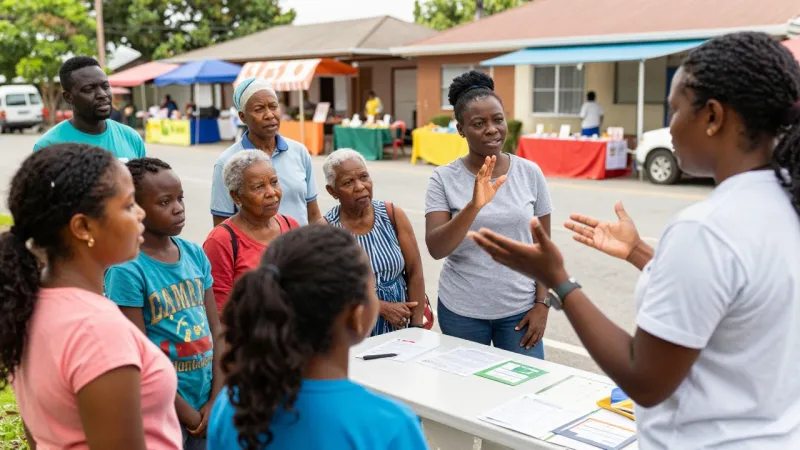
Photo: diverse community members gathered around a table with phones and paper flyers in a neighborhood meeting, via dioceseofvaranasi.org.in
Picture a town hall meeting where half the seats are empty — not because people don't care, but because the invitation only existed on Facebook. That's not a hypothetical. For millions of Americans living in low-income neighborhoods, rural counties, and communities of color, that's just Tuesday.
Community organizing has always been about showing up. Knocking on doors. Standing in church basements with bad coffee and a shared sense of purpose. But over the last decade — and especially since 2020 — a significant chunk of that organizing has migrated online. And the migration hasn't been equal.
The Widening Gap Nobody Wants to Talk About
According to the Pew Research Center, roughly one in five American adults doesn't use the internet. That number climbs sharply when you look at adults over 65, people without a high school diploma, and households earning under $30,000 a year. These aren't abstract demographics — they're the exact populations that community organizations are often trying to serve and mobilize.
When advocacy groups shift their newsletters to email blasts, their meetings to Zoom, and their petitions to Change.org, they're making an assumption: that everyone has a device, a reliable connection, and the digital literacy to navigate it all. In plenty of ZIP codes, that assumption is flat-out wrong.
The consequences ripple outward in ways that are easy to miss. A tenant rights group in a mid-sized Midwestern city might have 400 members on paper but only 80 who regularly see updates — because the other 320 don't check email or don't own smartphones. A neighborhood association might hold three virtual meetings before anyone realizes that the seniors most affected by a proposed zoning change never figured out how to unmute themselves on Zoom.
This isn't just an inconvenience. It's a structural problem that shapes who gets heard, who shows up at city council, and ultimately who has power.
When the Tools Meant to Connect Actually Divide
There's a particular irony at work here. Digital tools — social media, group chats, organizing platforms like Mobilize or Action Network — were supposed to democratize advocacy. And for some communities, they genuinely have. But for others, they've created a two-tier system where the already-connected get more connected, and everyone else falls further behind.
Take broadband access. The Federal Communications Commission has acknowledged for years that its maps of internet coverage are deeply flawed, often overstating availability in rural and low-income urban areas. Families in parts of Appalachia, the Mississippi Delta, and tribal lands have been promised high-speed internet for so long that the promise itself has become a running joke. Meanwhile, organizing efforts that depend on video calls and cloud-based tools are essentially asking these communities to participate in a race with one leg tied.
Even where internet access exists, device ownership is uneven. A shared family smartphone with a cracked screen and a prepaid data plan isn't exactly optimized for attending a 90-minute virtual advocacy training. And public library computers — long a lifeline for people without home internet — have limited hours, waiting lists, and restrictions on certain types of online activity.
Digital literacy adds another layer. Knowing how to use a device is different from knowing how to use it effectively for civic engagement. Navigating a city's public comment portal, signing up for a neighborhood alert system, or even just finding a local organization's meeting time online — these tasks that feel routine to some people are genuinely confusing barriers for others.
What's Actually Working on the Ground
Here's where it gets interesting. Because while the problem is real, so are the workarounds — and some of them are surprisingly creative.
In South Los Angeles, a housing advocacy group stopped relying on email entirely for its most vulnerable members. Instead, they trained a network of building captains — one resident per apartment complex — who receive digital updates and then physically walk the information to neighbors. It's essentially a human router system, and it works.
In rural North Carolina, a farmworker organization prints a simple one-page flyer in both English and Spanish every two weeks and distributes it through local tiendas, laundromats, and churches. The flyer includes a phone number people can text to get added to a call list. No app required.
Some groups are leaning into old-school phone trees with a modern twist — using free tools like Google Voice to set up a single number that broadcasts voice messages to hundreds of people at once. It's not glamorous, but it reaches people who would never open an email.
Others are working with local libraries and community colleges to offer digital skills workshops specifically designed around civic participation — teaching people not just how to use a computer, but how to use it to engage with their local government, find resources, and connect with advocacy networks.
The common thread in all of these approaches? They start with the community's actual reality, not an idealized version of it.
Rethinking What 'Accessible' Really Means
For organizations trying to do this work well, the digital divide forces a useful reckoning. It's easy to assume that because a tool is free or widely used, it's accessible. But accessibility isn't just about cost — it's about the whole ecosystem of requirements that come with a tool: reliable internet, a capable device, time, language, and confidence.
Some organizations are starting to audit their own outreach strategies the way they might audit their budgets — asking hard questions like: Who are we actually reaching? Who's consistently absent from our meetings, and why? What would it take to bring them in?
Those questions don't always have comfortable answers. Sometimes they reveal that an organization has drifted away from its most vulnerable constituents precisely because they're harder to reach digitally. That's a mission problem, not just a communications problem.
The Bigger Picture
None of this means organizations should abandon digital tools — they're genuinely powerful when used well. But the most effective community organizations tend to treat digital outreach as one channel among many, not the default or the finish line.
The neighborhoods that are managing to bridge this gap share something in common: they treat connection as a practice, not a platform. They invest in relationships — real ones, built over time — that can carry information and mobilize people regardless of whether everyone has Wi-Fi.
In a landscape where so much of civic life is moving online, that commitment to reaching everyone — not just the already-connected — might be the most radical thing a community organization can do.
And honestly? It's the kind of thing the word grassroots was always supposed to mean.